 Japan
Japan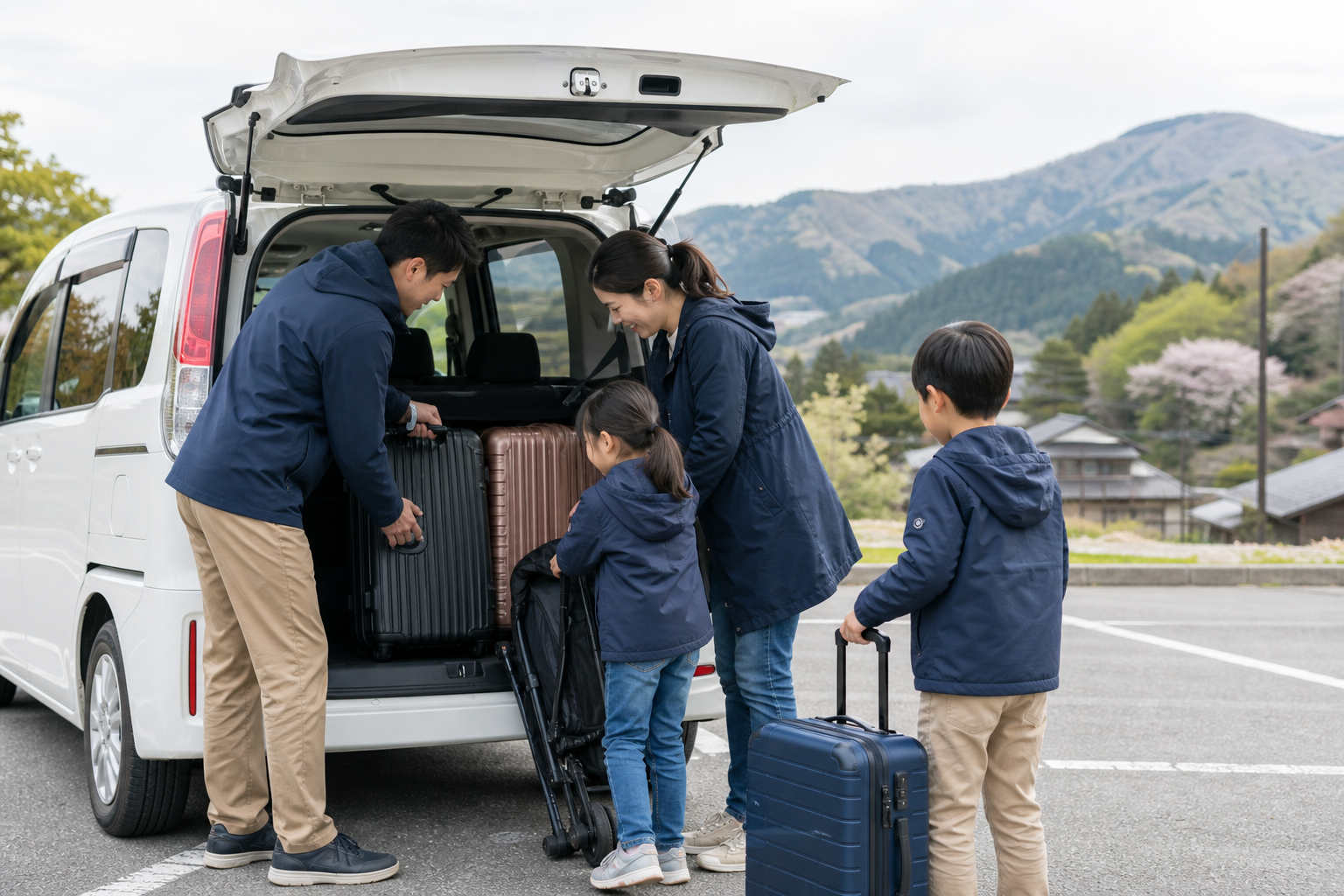
A good family rental car is not simply the cheapest car on the results page. It is the car that legally fits your driver, physically fits your people and luggage, and gives you a realistic plan for child seats, tolls, pickup, and the return trip.
This guide does not claim that one rental company is best for every family. Use it to narrow the vehicle and booking conditions first, then compare current offers.
The short answer
For two adults and one or two children, start by comparing a compact minivan rather than the smallest economy car when you have several full-size suitcases or a stroller. For a multigenerational group, prioritize door height, step-in height, a second-row seat that is easy to reach, and a pickup location that does not require multiple transfers.
A rental car is usually a stronger fit when your itinerary includes countryside stops, small towns, or accommodation away from major stations. Trains often remain easier for a city-only Tokyo–Kyoto–Osaka itinerary.
| Your trip | Better starting point |
|---|---|
| Major cities, light luggage | Train |
| Countryside, children, several bags | Rental car |
| Older travelers, city sightseeing, no confident driver | Private tour |
| First-ever snow driving in Hokkaido | Train, bus, or private transfer |
Try our train vs rental car vs private tour tool before opening booking sites.
1. Confirm that every driver can legally drive in Japan
Japan’s National Police Agency says visitors need an accepted licence route: a Japanese licence, a qualifying International Driving Permit under the 1949 Geneva Convention, or an eligible foreign licence with an approved Japanese translation. The exact route depends on the country or region that issued your licence.
Do not assume that any document called an “international driving licence” is accepted. Check the National Police Agency guidance for foreign licence holders before booking. Bring the original documents required for your route and your passport to the rental counter.
If the driver documents are uncertain, resolve that before comparing cars. A low price is irrelevant if the counter cannot release the vehicle.
2. Choose by usable luggage space, not passenger count
A listing that says “five seats” does not tell you whether the boot fits four people’s luggage. Build a simple luggage list before searching:
- number of full-size suitcases;
- carry-on bags and backpacks;
- stroller dimensions when folded;
- child-seat positions;
- mobility aids;
- space needed for shopping or a forwarding day bag.
Look for a luggage diagram, interior measurements, or a clearly stated model class. Vehicle models within one class can change, so treat example cars as examples rather than guarantees. If luggage fit is essential, ask the rental company to confirm the class and capacity in writing.
3. Reserve child seats with the car
JAF’s English traffic guidance states that a child younger than six must be secured in a child seat. Review the JAF traffic rules for driving in Japan, then check the rental company’s available seat types.
Before paying, confirm:
- the child’s age and approximate weight are accepted for that seat;
- the seat is available at your exact pickup branch;
- the quoted total includes the seat for the full rental;
- staff can show you the installation, while you remain responsible for checking the fit;
- you still have enough seating and luggage space after installation.
Families bringing their own seat should confirm compatibility, airline handling, and whether the rental vehicle has the attachment method they expect.
4. Compare the full trip cost
The lowest headline rate may exclude decisions that matter on a family trip. Compare the same items for every offer:
- base rental and taxes;
- child seats and extra driver;
- one-way drop fee;
- ETC card or toll arrangement;
- fuel policy;
- collision-damage waiver or other optional protection;
- non-operation charge rules;
- cancellation deadline and late-return terms.
Insurance language varies by company and marketplace. Read what is included, what remains payable, and which events are excluded. Do not treat “full coverage” as a universal legal definition.
5. Make pickup and return part of the itinerary
Airport branches can be convenient, but some require a shuttle and extra counter time. City branches may avoid an airport drive but add a luggage transfer. For families, the best branch is often the one that removes a difficult transfer rather than the one with the smallest daily rate.
Allow time to photograph the car, learn the navigation system, set child seats, and locate the fuel and return instructions. Avoid planning a long unfamiliar drive immediately after an overnight flight.
A practical booking sequence
- Confirm driver-document eligibility on the official NPA guidance.
- Decide whether a car is genuinely easier than rail for your route.
- Write down passengers, child-seat needs, and every large item.
- Compare a suitable vehicle class and the full included price.
- Read cancellation, protection, toll, fuel, and return terms.
- Confirm time-sensitive details with the rental company.
- Save offline copies of the booking, branch details, and emergency number.
Use the results as a comparison step after fixing those requirements. Confirm the supplier, vehicle class, included equipment, and complete booking terms before payment.
When not to rent
Choose another option when nobody is comfortable driving on the left, your plan is entirely around major stations, the driver documents are uncertain, or severe weather would make the trip a learning exercise. A private transfer or tour can cost more but remove navigation, parking, and driver fatigue. The right comparison is total trip friction—not just the transport price.